
Monday, July 20, 2009

Tuesday, June 30, 2009

Thursday, April 19, 2007
Example Golf Tournament Flyers
26 - 28 (7.5.) Mendelian rules, basic concepts (haploid, diploid, dominant, recessive, allele homozygous, heterozygous)
Georg Mendel = founder of the history of genetics. Erführte 355 intersections (7 characteristics) and examined the hybrids (hybrids)
In the selection of the examined plants, it was important that they are many and easily distinguishable duck Merkamle have two manifestations have -> GARDEN PEA
- seed shape
- seed color
- Blühtenfrabe
- Pod shape
- Schoten
color - the prime postition
- This pea shoot length
reproduces mainly by self-fertilization (autogamy = inbred). Therefore, Mendel had to remove the immature flowers the stamens targeted perform Investigate busbar systems to be able to speak prevent autogamy.
Furthermore, it was important to use pure-bred plants (= plants have shown several Geration no changes).
first crossed Mendel purple flowering peas together (anther one on ovaries of the other plant) = parents generation = Parental generation P
From the resulting Ebsen grew once purple flowering peas = daughter generation = Final Generation F1
=> This crossings (intersections with only one feature) is called mono hybrid cross (intersection near a feature taken) is
Then he crossed a purebred yellow pea with a pure green pea:

mono hybrid cross (inheritance)
seed color (characteristic)
yellow / green seeds (races)
The first filial generation F1 -> yellow seeds.
After crossing the Tocherganeration each other, he received the second filial generation F2 -> color ratio 3:1 (majority yellow)
==> KEY inheritance
therefore crossed Mendel the F2 generation to another,

50% yellow F2 seeds were at the crossing with each other => 3:1 (see the two groups of four in the middle)
crossing only green seeds of the F2 Generatin => 100% green seeds (see the foursome on the right)
25% of the yellow seed crossings => 100% yellow seeds (see group of four left)
Episode 3 Final revisions:
The third conclusion does not mean that some genes can overlap, and others. Depending on the combination, they will reappear in later generations.
overlapping genes = dominant, genes can be overlap = recessive .
Say appearance be (phenotype) and the combination of genes (genotype) must be distinguished.
consideration of the above shown test given phenotype and genotype

parental generation P is a purebred = homozygous , say they have two identical genes (in terms of the characteristic)
Man speaks of the green allele and the yellow allele (allele = a feature may appear in different forms, for example: flowers can be red or white). Sprcih the characteristic seed color comes in two variants of the phenotype before (time = yellow and one green seed).
The gene of the dye exists in two alleles.
F1 generation heterozygous = heterozygous
The individuals each have a yellow and one green genetic trait of the parents.
Menedl through these junctions with respect to all features and always came to the same conclusion:
http://www.mallig.eduvinet.de/bio/Repetito/Genetik.html
http:/ / www.merian.fr.bw.schule.de/beck/skripten/13/bs13-12.htm

- Mendelian rules -
Georg Mendel = founder of the history of genetics. Erführte 355 intersections (7 characteristics) and examined the hybrids (hybrids)
In the selection of the examined plants, it was important that they are many and easily distinguishable duck Merkamle have two manifestations have -> GARDEN PEA
- seed shape
- seed color
- Blühtenfrabe
- Pod shape
- Schoten
color - the prime postition
- This pea shoot length
reproduces mainly by self-fertilization (autogamy = inbred). Therefore, Mendel had to remove the immature flowers the stamens targeted perform Investigate busbar systems to be able to speak prevent autogamy.
Furthermore, it was important to use pure-bred plants (= plants have shown several Geration no changes).
first crossed Mendel purple flowering peas together (anther one on ovaries of the other plant) = parents generation = Parental generation P
From the resulting Ebsen grew once purple flowering peas = daughter generation = Final Generation F1
=> This crossings (intersections with only one feature) is called mono hybrid cross (intersection near a feature taken) is
Then he crossed a purebred yellow pea with a pure green pea:

mono hybrid cross (inheritance)
seed color (characteristic)
yellow / green seeds (races)
The first filial generation F1 -> yellow seeds.
After crossing the Tocherganeration each other, he received the second filial generation F2 -> color ratio 3:1 (majority yellow)
==> KEY inheritance
therefore crossed Mendel the F2 generation to another,

50% yellow F2 seeds were at the crossing with each other => 3:1 (see the two groups of four in the middle)
crossing only green seeds of the F2 Generatin => 100% green seeds (see the foursome on the right)
25% of the yellow seed crossings => 100% yellow seeds (see group of four left)
Episode 3 Final revisions:
- The inheritance of characteristics is based on genes. These genes are passed on unchanged to future generations.
- Each descendant inherit from his parents, only one unit (feature) The
- System need not be visible in the individual to be passed on to other GENRATION.
The third conclusion does not mean that some genes can overlap, and others. Depending on the combination, they will reappear in later generations.
overlapping genes = dominant, genes can be overlap = recessive .
Say appearance be (phenotype) and the combination of genes (genotype) must be distinguished.
consideration of the above shown test given phenotype and genotype

parental generation P is a purebred = homozygous , say they have two identical genes (in terms of the characteristic)
Man speaks of the green allele and the yellow allele (allele = a feature may appear in different forms, for example: flowers can be red or white). Sprcih the characteristic seed color comes in two variants of the phenotype before (time = yellow and one green seed).
The gene of the dye exists in two alleles.
F1 generation heterozygous = heterozygous
The individuals each have a yellow and one green genetic trait of the parents.
F2 generation plants gelbsamige 25% homozygous, 50% and 25% homozygous heterozygous gelbsamige grünsamige pea plants.
=> phenotypic segregation ratio = 3: 1 ledMenedl through these junctions with respect to all features and always came to the same conclusion:
- one allele is dominant (eg yellow seeds)
- one allele is rezenssiv (Eg green seeds)
- The genotype, despite the yellow phenotype YG, YY be
http://www.mallig.eduvinet.de/bio/Repetito/Genetik.html
http:/ / www.merian.fr.bw.schule.de/beck/skripten/13/bs13-12.htm
Thursday, April 5, 2007
Charmglow Natural Gas Conversion Kit
23rd - 25 (16.4.) 21 mitosis / meiosis
mitosis (cell division: Result are two identical cells)
-> Repeat:
third (6.11.2006) cell division - mitosis
mitosis - cell division (asexual reproduction)
The course a typical cell division is the same for plants and animals in most cases. It is a form and structure of the nucleus in each daughter nucleus has the same genetic heritage and all the parent nucleus.
course of the division:
(images and content of http://de.wikipedia.org/wiki/Chromosom )
 first Chromatid (chromatid). One of the two identical Parts of the chromosome.
second Centromere (the point of contact of the two chromatids)
third Short arm
4th Long arm
Both chromatid contain exactly the same DNA. The chromosome after the separation is only of a Tochterchromatid. Prior to re-separation, there must be doubled also.
question: Look at even more closely at how chromosomes are composed.

Question: What is the role of colchicine in mitosis? What is that, from which one gets it and for what purpose is it used?
Answer: Colchicine is a mitosis. It prevents the formation of spindle fibers. It will nevertheless go through the different phases and stopped nihct. The absence of the spindle stage may not align the chromosomes. The balance between sister chromatids is omitted -> in a cell division occurs without and one (not the cell nucleus without viable) with core. If the cell is again doubled, stribt from the animal cell, the plant cell is increased. (Plant breeding)
meiosis
Bei der Gametenbildung wird nur eine einfache Ausfertigung der Erbanlage weitergegeben (keine doppelte):
ABLAUF DER MEIOSE :
two sections:
prophase II :
metaphase II :
telophase II :
Bedeutung der Meiose:

mitosis (cell division: Result are two identical cells)
-> Repeat:
third (6.11.2006) cell division - mitosis
mitosis - cell division (asexual reproduction)
The course a typical cell division is the same for plants and animals in most cases. It is a form and structure of the nucleus in each daughter nucleus has the same genetic heritage and all the parent nucleus.
course of the division:
- working core (normal key) => Ab.b.: A
- is prophase (the nuclear and chromatin is in a Fadenknäudel, in which the chromosomes become visible as long thin filaments) => Ab.b.: B and C
- metaphase (chrome Some thicken, then passes through a longitudinal split) => Ab.b.: D and E
- anaphase (separation of the daughter chromosomes) => Ab.b.: F and G
- telophase (loosening of chromatin and return to work form) => Ab.b.: H
- working core (two new nuclei were created) => Ab.b.: IThe chromosome
(images and content of http://de.wikipedia.org/wiki/Chromosom )
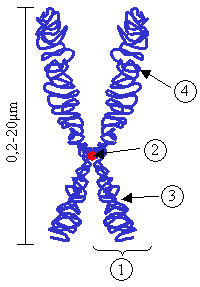 first Chromatid (chromatid). One of the two identical Parts of the chromosome.
 second Centromere (the point of contact of the two chromatids)
third Short arm
4th Long arm
Both chromatid contain exactly the same DNA. The chromosome after the separation is only of a Tochterchromatid. Prior to re-separation, there must be doubled also.
Humans have 46 chromosomes, 2 of the sex hormones make up (XX in females, XY for males).
tasks of chromosomes / cell division:- carriers of DNA
- cell division
- basis for the Gene / genotype
- disease-related variations can cause severe damage to lead
- growth
- wound healing
- asexually plan Zung
- .....
addendum on the basis of comments / questions:
question: Look at even more closely at how chromosomes are composed.

Answer: The chromosomes are composed of long chromosome threads (see figure), the "aufzwirbeln" several times. The divorced Zeilteilung purpose.
question: What happens when the natural life cycle of a cell (interphase - prophase - metaphase, etc., all these different phases last so long) to get messed up? In the form of what disease this is expressed in humans?
Answer: The chromosomes are not distributed correctly to the two daughter cells - created> cancer cells!
Question: What is the role of colchicine in mitosis? What is that, from which one gets it and for what purpose is it used?
Answer: Colchicine is a mitosis. It prevents the formation of spindle fibers. It will nevertheless go through the different phases and stopped nihct. The absence of the spindle stage may not align the chromosomes. The balance between sister chromatids is omitted -> in a cell division occurs without and one (not the cell nucleus without viable) with core. If the cell is again doubled, stribt from the animal cell, the plant cell is increased. (Plant breeding)
meiosis

Definition: Unter der Meiose oder Reifeteilung versteht man eine besondere Form der Kern- und Zellteilung, die in zwei Schritten zur Bildung von 4 Keimzellen (Gameten) führt und bei der der Chromosomensatz vom diploiden auf den haploiden Zustand reduziert wird.
Bei der Gametenbildung wird nur eine einfache Ausfertigung der Erbanlage weitergegeben (keine doppelte):
- Körperzellen -> dipoloiden Chromosomensatz -> 2x
- Gameten/Geschlechtszellen -> haploiden Chromosomensatz -> 1x
- Pflanzen: männliche Gameten -> Staubbeuteln; weibliche Gameten -> Fruchtknoten
- Tieren/ Menschen: männliche Gameten -> Hoden; weibliche Gameten -> Eierstöcken
Daher wird die Meiose zur Chromosomensatzreduzierung verwendet (Meiose wird daher auch als Reduktiosteilung bezeichnet). NAch Verschmelzung der Geschlechtszelle ist wieder ein diploider Chromosomensatz vorhanden.
- Mitose -> 2 identische Tochterzellen (zu Beginn haploid, haben allerdings die Fähigkeit die Chromosomen zu verdoppeln -> diploid)
- Meiose -> 4 nicht identische Gameten (haploid)
ABLAUF DER MEIOSE :
two sections:
- first Meiosis: meiosis I -> pairing of homologous chromosomes / Crossing Over
- second Meiosis: Meiosis II -> as mitosis
As divisions between the no DNA synthesis takes place (no new cells are formed, ie no duplication of the DNA) occur after the cell divisions four haploid cells.
first Meiosis :
prophase I : 
longest phase of meiosis
- In the cell there is a diploid set of chromosomes, one haploid set of chromosomes from the mother and the father to arise.
- The two chromatids screws to -> long, thin filaments are visible -> two homologous pairs of chromosomes (sister chromatids).
- homologous chromosomes lie then another parallel (centromere to centromere) -> 4 parallel chromatids (tetrad)
- If the non-sister chromatids cross over fragments are exchanged of chromatid -> chiasma (crossover) = Crossing Over . This occurs randomly.
- Centriolenpaare move away from each other -> the spindle fibers are formed -> nuclear envelope and nucleoli dissolve
metaphase I : 
chromosome pairs arranged on both sides in the center of the cell between the spindle apparatus of
- spindle fibers connect to the nearby centromere
anaphase I : 
purpose of separation of homologous chromosome pairs
The sister chromatids are drawn to the poles of the spindle Lappe Council, thereby separating dei is homologous pairs of chromosomes
haploid set of chromosomes at each pole of the spindle Lappe Council
random arrangement and distribution of the maternal and paternal chromosomes
telophase I : reach 
Chromosome Pole - Screw> initiation of cell division
chromosomes are
The cytoplasm is divided
chromosome has (! in contrast to mitosis) now its two chromatids -> two different cells
difference male / female cells: male -> separation into two equal-sized cells; female -> only a cell formed complete, another is a smaller cell, with the large Egg related
It is then followed without interphase, prophase II fluently.
2. Meiosis:prophase II :

Chromosome screw formed on
formation of a new spindle apparatus
chromosomes to the equatorial plane pulled
decay of nuclear membrane and nucleolus
metaphase II :

- arrangement of chromosomes by means of centromeres to the equatorial plane
anaphase II : 
- The sister chromatids are separated at the centromere and migrate to the cell poles (Note: the sister chromatids are due the 1st meiosis ! Not identical)
telophase II :

- chromatids are located at the poles
- nuclei formed
- created division of the 2 cells 4 cells with haploid chromosome set!
- male sex cells (spermatocytes) -> four gleich große Zellen (Spermatiden) -> Entwicklung zu Spermien
- weiblichen Geschlechtszellen (Oocyte) -> eine große/fruchtbare Eizelle + drei kleine/unfruchtbare Richtungskörperchen (haben keine Funktion)
- Chromosome verschrauben sich
Bedeutung der Meiose:
- Bildung der haploiden Geschlechtszellen
- Durchmischung des Erbgutes
http://www.webmic.de/meiose.htm#reife1
http://www.zum.de/Faecher/Materialien/beck/bs11-71.htm
Subscribe to:
Posts (Atom)